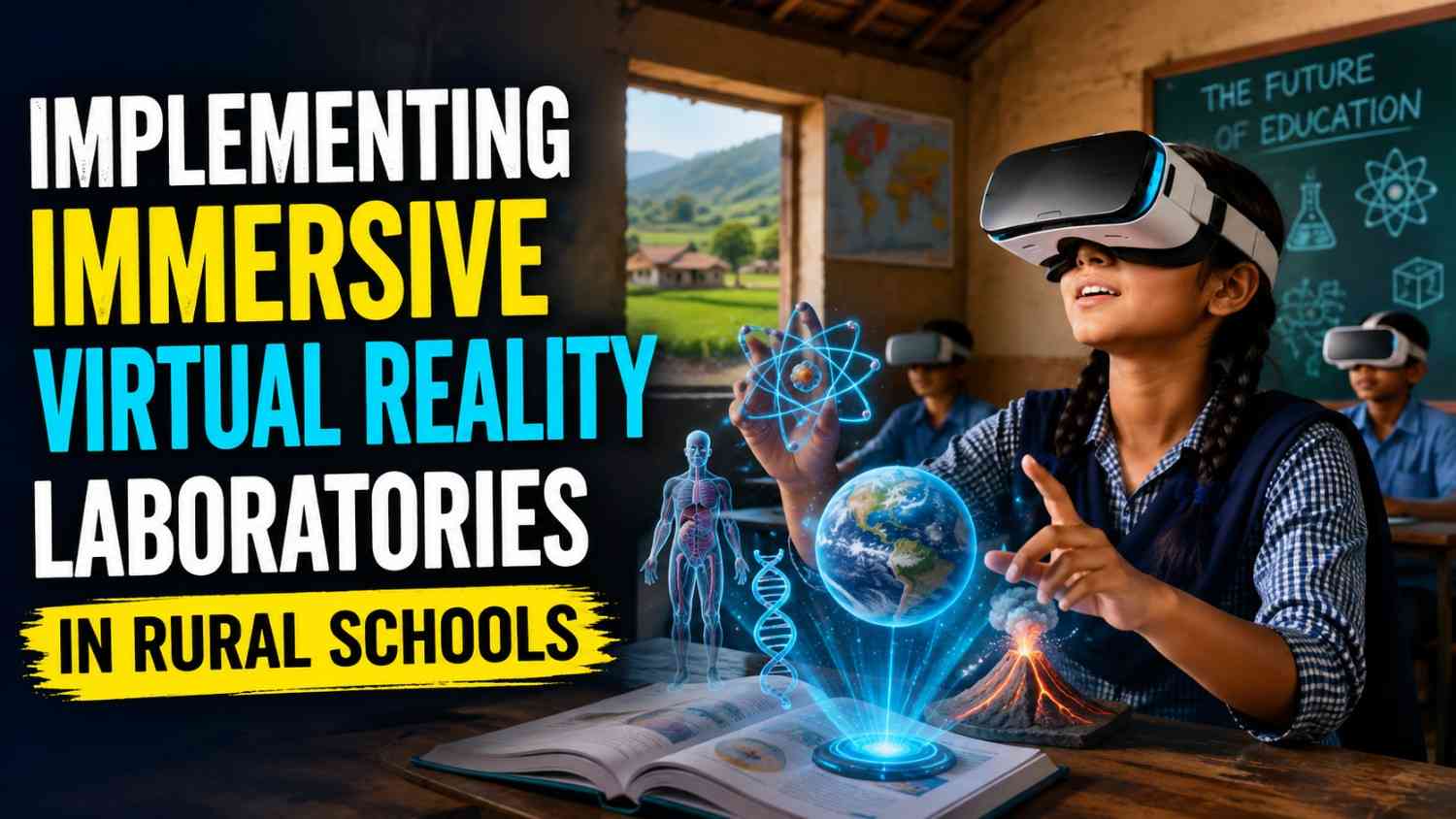
Virtual Reality Laboratories In Rural Schools: Imagine a classroom in a remote village where students huddle around worn textbooks, dreaming of exploring the human body, ancient civilisations, or distant ecosystems–experiences that feel out of reach due to limited resources, distance, and budgets. Imagine those students wearing lightweight headsets and walking into immersive, interactive worlds in which students can dissect virtual animals and lizards without risk, stroll through historic monuments or carry out chemical experiments with safety. This isn’t a science-fiction story; it’s the reality of Virtual Reality (VR) labs, which are changing education in the most underserved regions.
As someone who has been following technological advancements in education for many years, I’ve observed the ways in which VR can bridge the gaps that traditional methods are unable to close. In rural schools that have access to modern labs, skilled experts, or field trips are frequently scarce, VR can be a chance to even all playing field. Let’s examine why this is so important, as well as the real-world advantages and practical steps to implement it, and the challenges to anticipate and examples that show that it’s possible.
Why Rural Schools Need Immersive Virtual Reality Laboratories
Rural education faces unique hurdles. Many schools operate on tight budgets, outdated facilities, and teachers are under-resourced, specifically in STEM disciplines. Students may not visit a museum of science or a coral reef, or even a lab with high-tech equipment. The physical experiments can be expensive or dangerous, and materials run out fast.
Immersive VR alters the dynamic. Utilising headsets and special software, students are able to experience 3D spaces that appear extremely real. Students interact with the objects they encounter, make a decision and get immediate outcomes. Research shows that this approach to hands-on learning increases engagement and retention, which is far more than the content of videos or lectures.
One of the main advantages has to do with access. VR labs do away with the requirement for costly physical equipment. One headset will allow you to run a variety of experiments from gravity simulations in physics to biology-based explorations of cell structures. In the life sciences, for instance, students at remote South African schools using virtual labs made significant progress in understanding concepts as well as developing abilities such as observation, measurement and understanding data.
Security is a further major win. Students can “handle” hazardous materials or play in dangerous environments with no real risk. This stimulates curiosity and allows experimentation and fosters a mindset of growth in which mistakes can be used to learn instead of being negative.
VR is also able to support individualised learning. The latest platforms can be adapted to individuals’ learning needs. Students who require more time with a particular subject can go back to their simulations, while others can tackle problems. This is especially useful in rural schools with mixed abilities, in which a standard curriculum often leaves certain students behind.
Beyond the academic, VR builds broader skills. It improves thinking about space, problem-solving and collaboration, especially when students share their experiences or participate in multiplayer virtual environments. For a majority of rural students, it can open doors to career opportunities in engineering, technology and science, by making these fields real and thrilling.
Real Benefits Backed by Experience
The effect is more extensive than the scores on tests. Research shows that better retention of knowledge, with certain VR-enhanced biology classes, results in greater performance and higher retention rates for related subjects. The students report being more absorbed and inspired. Learning doesn’t feel like an effort when you’re moving through the bloodstream or creating virtual circuits.
In rural environments, VR brings the world closer. Virtual field trips allow students to “visit” global landmarks, forests or space stations without leaving the classroom. A Texas middle school made use of VR to conduct explorations that a lot of students were able to experience for the very first time, creating excitement and discussion.
Equity is also improved. Students with a low percentage of girls or underrepresented in STEM typically gain confidence from these safe, interactive forms. Cost savings are evident as time passes: even though the initial investment is made, VR reduces recurring expenses for transportation, consumables and even the maintenance of labs that are physically located.
Teachers can also benefit. VR tools can enhance education, allowing teachers to be more focused on coaching and delivering high-quality, standardised content. If properly trained, educators become facilitators of discovery, rather than just information suppliers.
Steps to Implement VR Labs Successfully
Getting started doesn’t require a massive overhaul. A planned, gradual method is best suited to schools in rural areas.
1. Review Needs and Readiness. Start with an evaluation of the entire school. Which subjects are most beneficial? The sciences and the past are usually at the top of the list. Be sure to check the infrastructure: reliable electricity is vital, and even though high-speed internet is helpful for updates and cloud-based content, many headsets that are standalone are offline. Ask students and teachers to make the purchase.
2. Select the right technology for durable, user-friendly solutions made for teaching. The standalone headsets (like the ones from established companies) are popular since they don’t require a computer with a powerful processor. Begin with a smaller set of perhaps one classroom set with 10-20 headsets distributed across the grades. Search for platforms that have curriculum-aligned content libraries that cover a variety of subjects.
Cheap alternatives, such as basic viewers, when paired with smartphones that are already in use, could be used as entry points prior to moving to fully immersive systems.
3. Secure Funding Creatively. This is often the most feared obstacle. However, opportunities are available. Federal programs such as Title I support schools serving students with low incomes. Grants from organisations that are focused on rural education and technology, STEM initiatives, or digital equity could be helpful. Certain districts have succeeded in repurposing textbook budgets or used one-time federal relief funds to fund VR pilots.
Tech companies that partner with local businesses or universities can result in discounts or donations of equipment. Crowdfunding campaigns featuring the stories of students also resonate with communities.
4. Facilitate Comprehensive Training. Comfort for teachers is vital. Provide hands-on training, possibly via online modules or cooperation with local colleges. A lot of VR providers offer teacher dashboards to make it easy to manage and integrate lessons. Begin with easy activities to build confidence before more advanced simulations.
5. Integrate into the curriculum, aligning VR with the existing curriculum standards instead of using it as an additional feature. Biology units could combine conventional lessons with virtual dissections or subsequent discussions. Mix in hands-on exercises when you can for an innovative approach that enhances the learning.
6. Monitor, evaluate and Repeat Tracking engagement and performance, as well as feedback with simple surveys and tests. Change based on the results – maybe additional social studies material and shorter time slots to reduce fatigue. Reward your successes to keep the momentum going.
Overcoming Common Challenges
Rural implementation can be a challenge; however, it can be overcome with proper planning.
Internet and Connectivity. In many areas, there is poor internet connectivity or no power. Stand-alone devices can help with this. Community partnerships or solar backups to charge stations may assist. Content is often downloaded ahead of time.
Cost Control: Headsets can range from a few hundred dollars; however, grants and shared use can extend budgets. Savings on supplies over time make it feasible. Pilot programs show value prior to making a full commitment.
teacher training and acceptance: Certain educators are concerned about the steep learning curve. Support for ongoing in the form of peer mentoring, as well as starting small, are ways to address this. Many teachers find VR helps in their instruction once they are familiar with it.
Health and Comfort: Motion sickness can affect some people. Begin with a limit on the first session, ensure that the correct fit is maintained, and give breaks. Modern headsets are more lightweight and comfortable, and come with guidelines to ensure safe use.
Access and Equity: Make sure that every student is included, even students who have disabilities (many systems provide accommodation). Rotate schedules so everyone benefits.
Participation in the community helps to overcome doubt. Demos of parents and open communication help build trust.
Inspirational examples from the field
Stories from real people prove that it works. For instance, in South Africa, grade 10 students at rural schools who used virtual life science labs performed better than students in traditional classrooms and gained a greater understanding of concepts and practical knowledge.
Within the United States, programs in states such as Arkansas have been rolling out VR in hundreds of schools, even rural ones and have shown positive results in learning. Texas schools have embraced it to explore virtual worlds and have broadened the horizons of students with limited travel options.
Internationally, the efforts of China and India illustrate the role that VR can play in bridging the urban-rural divide by utilising virtual labs to support science education, despite shortages of teachers.
These cases demonstrate the fact that success is based on communities’ support as well as gradual rollout and focusing on education goals instead of flashy technology.
Looking Ahead: A Brighter Future for Rural Education
As the cost of hardware continues to fall and libraries of content grow, VR will be more accessible. The latest developments of tactile feedback (touch sensations) and AI personalisation will provide more immersive experiences. Hybrid models that blend VR and augmented reality can improve the quality of everyday lessons.
The larger idea is to empower. Rural students should have equal opportunities to their urban counterparts. Immersive VR labs aren’t a substitute for great instructors or live-action interactions; they enhance them, resulting in lasting, efficient learning that helps young people prepare for a technologically-driven future.
Schools that take this seriously can create excitement, boost outcomes, and encourage the future generation of innovative students. If you’re in the field of rural education, you should start discussions about VR now. VR is here for use by our students.
This isn’t about replacing traditional education, but rather improving it. Through carefully planned collaboration, planning, and a focus on students’ demands, immersive VR labs will help rural schools shine more than ever before. What do you think about how you can bring this to your school? I’d like to hear about your experiences or suggestions by leaving a comment.