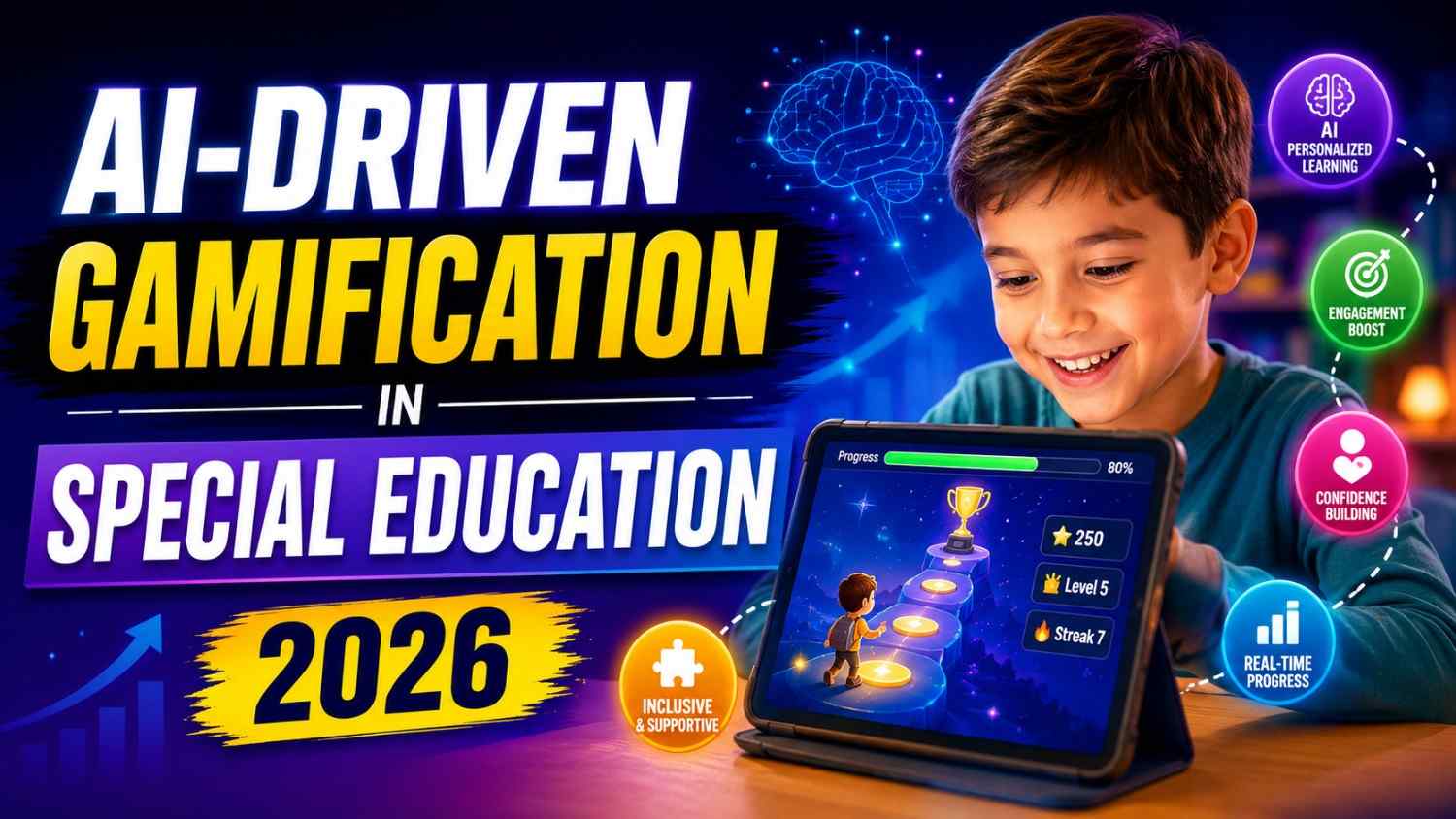
AI-Driven Gamification: Imagine a class in which every child is the protagonist in their own tale. For children in special education, this isn’t only a dream, it’s a reality in 2026 due to the clever blend with artificial intelligence as well as gaming. As someone who’s been following education technology for a while, I’m thrilled by the way these tools can create more engaging, inclusive education experiences which meet students wherever they are.
Let’s discuss what this might look like in real life. Traditional special education typically faces issues like different attention levels, different processing speeds, and the requirement to provide highly individualised assistance. AI-driven gamification is an ally and transforms lessons into interactive experiences that change in real-time. This isn’t about retraining teachers, far from it. It’s about providing educators with powerful allies that open them to creating stronger bonds with their students.
What Do We Mean by AI-Driven Gamification?
Gamification is simply taking the elements that we enjoy from games, like badges, points, levels, as well as challenges and immediate feedback, and applying them to learning. You can add AI in the mix, and these elements will become intelligent. The system learns from every pupil’s behaviour, addresses difficulties on the fly and provides encouragement that is tailored to each student’s individual style.
In 2026, we’re witnessing platforms that not only give correct answers but also recognise the patterns of how a child learns. Perhaps one child is awed by puzzles that are visual, while another enjoys story-driven challenges. AI detects this and adjusts in the same direction. This kind of personalisation is particularly valuable for special education, where one-size-fits-all methods are rarely effective.
Why Special Education Needs This Approach
Special education students are incredibly diverse. Some might suffer from the autism spectrum, whereas others have ADHD dyslexia, dyslexia or have multiple requirements. Many struggle when they are faced with monotonous tasks, difficulties staying focused, or issues with traditional methods of assessment. Gamification can help make learning less of an obligation and more like a game.
Real-world research and implementations have shown that when learning is a pleasure and a little less stressful, students stay longer and are more likely to retain their knowledge. AI enhances this by providing gentle guidance, without judgment. If an individual is having trouble understanding the concept, AI could offer suggestions via a friendly voice or break it down into smaller, manageable steps – much like a great coach could.
Teachers and parents often tell the stories of children who did not like math, but now spend more time playing math-related adventure game due to the fact that it is enjoyable and secure. The shift from “I have to” to “I would like to” is an empowering experience.
Real-World Applications Making a Difference
Let’s take a look at some of the practical ways in which this is taking place in 2026’s classrooms.
for reading or Language Skills: Tools that include AI narration and stories that adapt the pace and vocabulary. Dyslexic students may encounter a story in which it is the AI emphasises text in useful ways, or provides audio support that changes according to their development. Game-based elements, such as the collection of “story gems” for comprehension milestones, help keep the motivation up.
Math and Problem-Solving Platforms, such as the enhanced versions of games inspired by Prodigy, allow students to experience virtual worlds where their math abilities allow them to explore new areas. AI alters the complexity of a problem in real-time. If a child is able to master adding quickly, the system slowly introduces similar concepts without overwhelming the student with too much. The rewards for perseverance are not simply speeding up the process reward the effort, which increases confidence.
Educational and Social Learning. For students who are working with emotional regulation or communication, AI-powered role-playing scenarios offer secure practice areas. The virtual character can help a student navigate a “conversation quest” in a simulation of a school hallway, giving positive reinforcement as well as alternative methods if required. This is especially helpful in developing social skills in a controlled space.
Executive Functioning Assistance: Many students benefit from tools that encourage gamification of organisation as well as the management of tasks. AI is able to create customised daily tasks with visual progress bars and reminders that resemble games, and reward points for the completion of tasks. In time, this can help to build up the independence of AI.
One of the most innovative aspects that will be in place by 2026 is the incorporation of options that are sensory-friendly. Developers are becoming more conscious of the user interfaces they can customise, which means reducing visual clutter, providing calm options, or even allowing kids to choose their character’s adventure style.
The Teacher’s Perspective
Teachers working in special education typically have multiple responsibilities. AI-powered tools ease the administrative burden so that they can concentrate on the things that matter most to them: creating meaningful interactions. Platforms can produce progress reports, suggest individual adjustments, and can even assist with lesson planning, while also identifying areas where students might require additional support from a human.
A special education instructor could look over AI data to determine that a specific student is best in group challenges rather than one-on-one ones. This method of data-driven decision-making leads to more effective IEP (Individualised Education Program) strategies, but without replacing the teachers’ human insights that they have to offer.
Collaboration among therapists, teachers and parents has also been improved. Dashboards that are shared and gamified help all to recognise small victories with each other.
Benefits Beyond the Basics
The benefits extend beyond academic gain:
- Higher Participation: Once disengaged, students are now looking forward to classes.
- Building resilience: Failure to complete a task in the game can be like failing a test, but it’s part of the process and encourages a positive mental attitude.
- accessibility: Controls for voice, adjustable interfaces, and multi-modal learning (seeing, hearing, and doing) provide a wide range of requirements.
- Social Skills Building: Multiplayer options created with inclusion in mind. Students can positively practice collaboration.
- Motivation through Mastery: The system recognises each stage of progress as it helps students recognise their own progress.
Reports from classrooms and studies in the past show consistent gains in academic performance as well as emotional well-being when these methods are applied carefully.
Addressing Challenges Thoughtfully
Of course, there is no way to make technology flawless. By 2026, our world of education will be working on key aspects:
Security and Privacy: Strong safeguards protect the privacy of student information. Families are grateful for clear policies regarding the way information is stored and used.
Digital equity: The schools are experimenting with innovative ways to guarantee access to the internet, whether via devices provided by the school or hybrid options that combine hands-on and digital activities.
Balanced Implementation: The best way to use technology is in conjunction with human contact. The aim is to improve, not substitute for, the relationship between teacher and student.
Professional Development: The teachers receive instruction not only on the tools but also on how to interpret AI insights in a way that is effective.
Educational and development professionals are working more than ever to make sure that these platforms are inclusive from the very beginning, from the ground up.
Looking Ahead in 2026 and Beyond
As we approach 2026, we’re witnessing more advanced integrations. Virtual and augmented realities are getting more readily available, allowing students to learn concepts in engaging ways, such as “visiting” historical sites or manipulating science experiments safely using virtual technology.
AI is also becoming better at recognising emotional signals (with appropriate consent and security measures) and could provide prompt help when a student is unhappy.
The trend is pointing towards highly personalised learning environments where gamification is more natural than being a novelty. The growth of the market for educational gamification is a reflection of this excitement, and projections show that the market will continue to grow as tools are sophisticated.
It is important to keep the focus on the empowerment of students. These tools help students build not just academic capabilities but also self-confidence, resilience and a passion for learning that will last into adulthood.
A Brighter Path Forward
The importance of AI-driven gamification within special education isn’t just about making flawless students, or substituting human-guided instruction. It’s about removing barriers that are unnecessary and highlighting every child’s individual strengths.
If a student who was struggling with traditional methods shows a flash of light because they’ve levelled up in their understanding, that’s what’s magic. Teachers are energised too and are witnessing their students flourish in ways previously thought beyond their reach.
While we continue to explore possible solutions, the most important thing is to keep students and their requirements at the forefront. Technology should benefit humanity by providing more opportunities for each student to be successful according to their own preferences.
Teachers, parents and policymakers who thoughtfully use these tools can help create a world that is a world where special education really means an education that recognises the uniqueness of each child. The future of 2026 will be more engaging and inclusive, and more exciting than it has ever been.
The journey continues; however, the direction is right. Every child deserves learning as a journey in which they can be successful. Thanks to AI-driven games, more children are getting the chance every day.