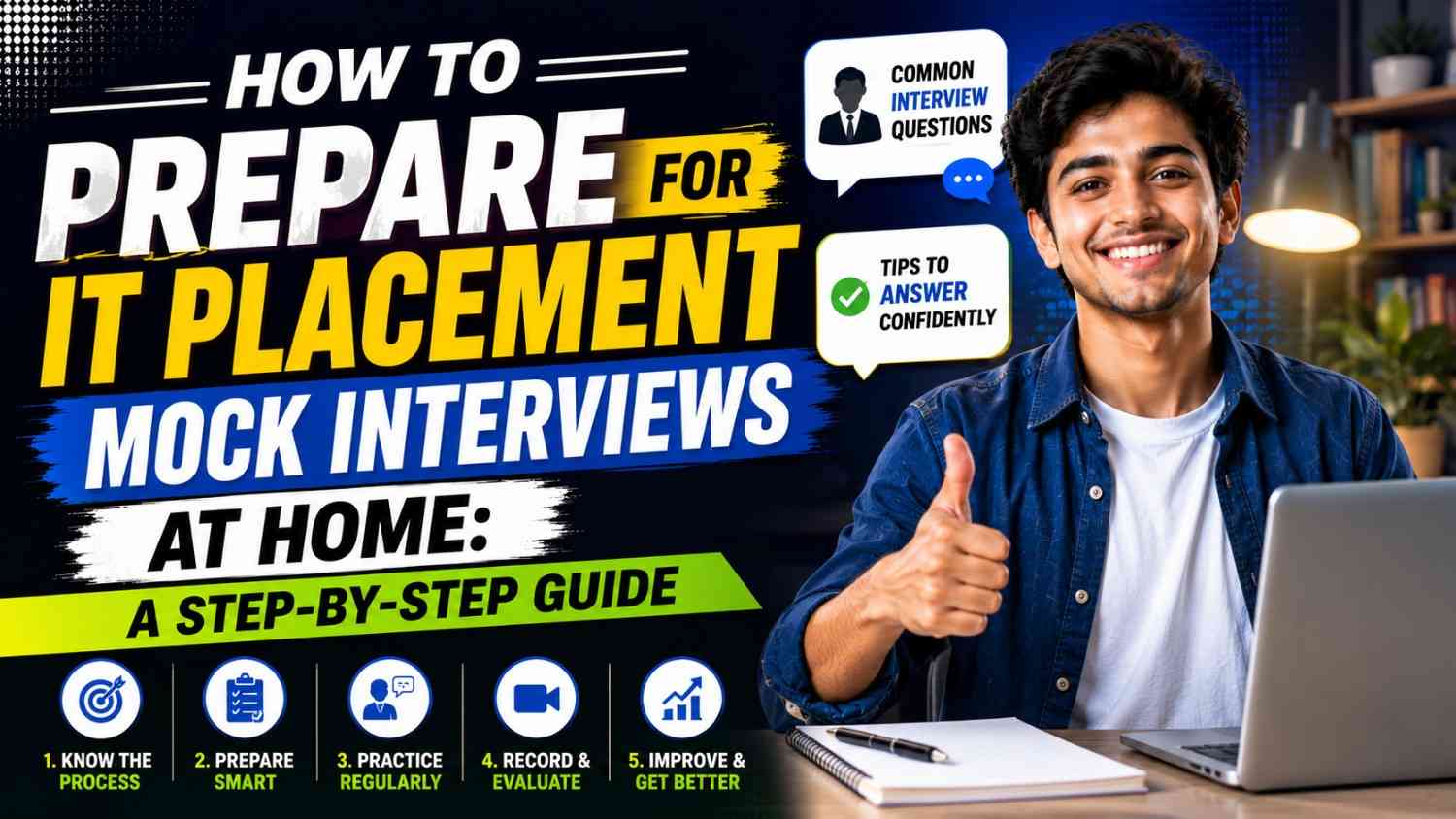
How to Prepare for IT Placement Mock Interviews at Home: For a large number of fresh and undergraduate graduates, the job interview is among the most crucial steps to getting a job in the IT sector. Although technical expertise is important, the interview’s performance is usually what determines if a candidate is offered a job or is turned down for a chance.
The best part is that you don’t require expensive coaching programs or expert interview trainers to get prepared effectively. With the right method, you can conduct extremely efficient mock interviews in your home and greatly increase your confidence, skills in communication and technical proficiency.
This guide offers a step-by-step procedure for preparing yourself for IT mock interviews for placement at home. If you’re looking for software development, tests, cloud computing, data analytics, cybersecurity, or IT support positions, these tips can assist you in preparing for interviews.
Why Mock Interviews Matter
Many applicants spend a long time studying the basics of programming, aptitude questions and technical subjects. However, once the interview starts, nerves frequently affect their performance.
Mock interviews can help bridge the gap between candidates and employers to:
- Practice answering questions under pressure
- Improve communication skills
- Recognise weaknesses before the interview
- Create confidence
- Learn to structure responses efficiently
- Reduce the anxiety of interviews
The more authentic these mock interviews are, the more prepared you’ll be for real placement interviews.
Step 1: Understand the Interview Process
Before beginning mock interviews, be aware of the typical structure of an IT selection process.
The majority of companies adhere to these steps:
Online Assessment
This could include:
- Aptitude questions
- Logical reasoning
- Coding challenges
- Communication skills
Technical Interview
Common topics covered are:
- Programming languages
- Data Structures
- Algorithms
- Database Management Systems
- Operating Systems
- Computer Networks
- Object-Oriented Programming
HR Interview
These areas of focus include:
- Self-introduction
- Career goals
- Teamwork experiences
- Strengths and weaknesses
- Situational questions
Knowing what you can expect will help to create realistic mock interviews.
Step 2: Create a Professional Interview Environment
One of the most common mistakes students make is practising at a casual pace on couches or beds. This doesn’t simulate an actual interview.
Instead:
- Place yourself at a desk or table
- Use the correct lighting
- Put on professional attire
- Keep your resume handy
- Remove distractions
- Keep your background clean
If your company is conducting virtual interviews, make sure you practice using videoconferencing tools, too.
A professional setting can help to make you more comfortable with the interviewing conditions.
Step 3: Prepare a Strong Self-Introduction
The majority of interviews begin with:
“Tell me about yourself. “
This simple question gives your first impression.
A well-written introduction should include:
- Your name is
- Background in education
- Technical abilities
- Academic projects
- Training or certifications
- Career interests
Structure example:
“Hello, my name is Rahul Sharma. I recently completed my Bachelor’s degree in Computer Science. During my academic journey, I developed strong skills in Java, SQL, and web development. I worked on a project involving an online learning platform where I contributed to backend development. I am passionate about software engineering and eager to begin my professional career in the IT industry.”
Rehearse your introduction several times until you feel like it is natural, confident and sensible.
Step 4: Build a List of Common Technical Questions
Create an inventory of questions that is based on the role you want to play.
Programming Questions
Examples:
- How do you define object-oriented programming?
- Define inheritance.
- Differences between array as well as linked lists.
- What is the term “recursion?
- Explain exception handling.
Database Questions
Examples:
- How can you define normalisation?
- Differentialities Between SQL in comparison to NoSQL databases.
- What is the key that is the primary?
- Explain joins.
Operating Systems
Examples:
- What’s the procedure?
- How do you define multithreading?
- Explain deadlock.
Computer Networks
Examples:
- What is TCP/IP?
- There is a difference between HTTP and HTTPS.
- What is DNS?
At least, collect 100 commonly asked questions, then practice answering these in mock interviews.
Step 5: Record Yourself Answering Questions
Recording yourself is among the most effective ways to prepare for interviews.
Use:
- Smartphone camera
- Laptop webcam
- Software to record screen images
When reviewing the tape, consider:
- Eye contact
- Clarity of voice
- Speaking speed
- Body language
- Confidence level
- Words that fill in the blanks, such as “um,” “like,” and “you know”
The majority of candidates are amazed by the patterns they see while watching themselves.
Recording sessions regularly can significantly increase communication abilities.
Step 6: Practice Coding Interviews
Software development jobs. Coding interviews are very frequent.
During mock interviews with coding:
Set a Timer
Allocate:
- Simple problem Time: 15 minutes
- Medium problem: 30 minutes
- Complex problem: 45 min
Think Aloud
Interviewers are often able to evaluate your thought process.
Explain:
- Problem understanding
- Potential strategies
- Time complexity
- Space Complexity
Review Solutions
After resolving:
- Analyze mistakes
- Improve efficiency
- Think about alternative ways to approach
Continuous practice with coding improves both problem-solving and technical skills.
Step 7: Conduct Mock Interviews with Friends
A friend could be the interviewer while you take questions.
Benefits include:
- Interaction in real-time
- Unexpected follow-up questions
- Better simulation of real-time interviews
- Feedback immediately
Plan a structured meeting:
Round 1: Introduction
5 minutes
Round 2: Technical Questions
20-30 minutes
Round 3: Project Discussion
15 minutes
Round 4: HR Questions
10 minutes
After the session, ask for honest feedback.
Critical criticism is crucial to improve.
Step 8: Master Project-Based Questions
Many IT interviewers spend time talking about projects in your résumé.
Prepare to provide the following information:
- What was the goal of the project?
- What tools did you utilise?
- What were the challenges you faced?
- What did you contribute?
- What changes would you like to suggest?
Do not memorise answers to scripts.
Make sure you understand the task thoroughly to be able to be confident in discussing it.
Discussions in project meetings often demonstrate real-world experience and problem-solving skills.
Step 9: Improve Communication Skills
The technical knowledge alone isn’t enough.
Effective communication can help interviewers see your skills easily.
Practice:
Speaking Clearly
Beware of rushing.
Using Simple Language
Simply explain the technical terms.
Active Listening
Be attentive when answering.
Structured Responses
This format is suggested:
- Situation
- Action
- Result
This method keeps the answers organised and professional.
Step 10: Prepare for HR Questions
Many applicants focus on technical training and leave out the HR interview.
Common HR questions include:
- Tell me about your personal life.
- Why should we choose you?
- Your strengths?
- What are your weak points?
- What do you think of yourself within five years?
- What are the reasons you would like to get into IT?
Try these questions several times.
Your answers must be authentic, clear, concise and professional.
Step 11: Learn to Handle Difficult Questions
Sometimes, interviewers deliberately ask tough questions.
Examples:
- You are unable to answer questions in a moment
- Problems with the situation
- Complex technical concepts
Instead of frightening yourself:
Stay Calm
Think about it for a while.
Be Honest
If you’re not sure, tell the person in a polite manner.
Show Your Thinking
Discuss how you’d go about solving the problem.
Interviewers typically value the ability to solve problems over memorising answers.
Step 12: Track Your Progress
Make a journal for interview preparation.
Record:
- The date of the mock interview
- Questions are asked
- Making mistakes
- The areas that require improvement
- Rating of confidence
Weekly tracking helps you identify patterns and measure growth.
In time, you’ll be able to see significant improvements both in your technical and interpersonal abilities.
Step 13: Simulate Real Interview Pressure
As the time for placement approaches, prepare mock interviews that are more real.
Consider:
- Limits on time
- Dress code for formal wear
- Unprepared questions
- Camera-on sessions
- Multiple interviews
The closer your practice is to real-life interviews and interviews, the more relaxed you’ll feel during the actual interview.
Step 14: Prepare Questions for the Interviewer
A lot of interviews end with:
“Do you have any questions for us? “
Always make sure you have questions that are thoughtfully planned.
Examples:
- What would a typical day in this job appear like?
- What are the technologies that the team currently utilize?
- What learning opportunities are there for recent graduates?
- How do you evaluate performance?
Inquiring about relevant issues shows interest and professionalism.
Step 15: Conduct a Final Mock Interview Week
One week before the placements:
Day 1
Simulation of technical interviews
Day 2
Simulation for coding interview
Day 3
HR interview simulation
Day 4
Project discussion practice
Day 5
Communication and presentation training
Day 6
Full-length interview simulation
Day 7
Re-evaluate your mistakes and take a break.
This method of organisation ensures thorough preparation.
Common Mistakes to Avoid
Many candidates do not realise they made mistakes in the process of preparing for an interview.
Avoid:
- Learning answers word-for-word
- Ignoring communication skills
- Avoiding preparation for projects
- Practice inconsistently
- Talking too fast
- Complex answers
- Neglecting HR interview preparation
Concentrating on these areas could dramatically improve the performance of interviews.
Final Thoughts
Making preparations for IT placement interviews from your home is not just possible but also highly effective if carried out in a systematic way. Mock interviews are an opportunity to practice in a safe setting, making mistakes and learning before presenting to real interviewers.
The most important thing is consistency. Just 30 to 60 minutes per day of mock interview training will result in noticeable gains in confidence, technical clarity, and communication skills.
Keep in mind that interviews are not intended to measure your ability to be perfect. They’re a chance to showcase your ability to solve problems, your knowledge, your attitude, and your willingness to take on new challenges. If you follow a well-planned method of mock interviews in your home environment, you will be able to take on the placement process with confidence and greatly improve your chances of achieving success.
Get started today, be steady, and consider every interview like a learning opportunity. Your future career opportunities could depend on how well you prepare now.