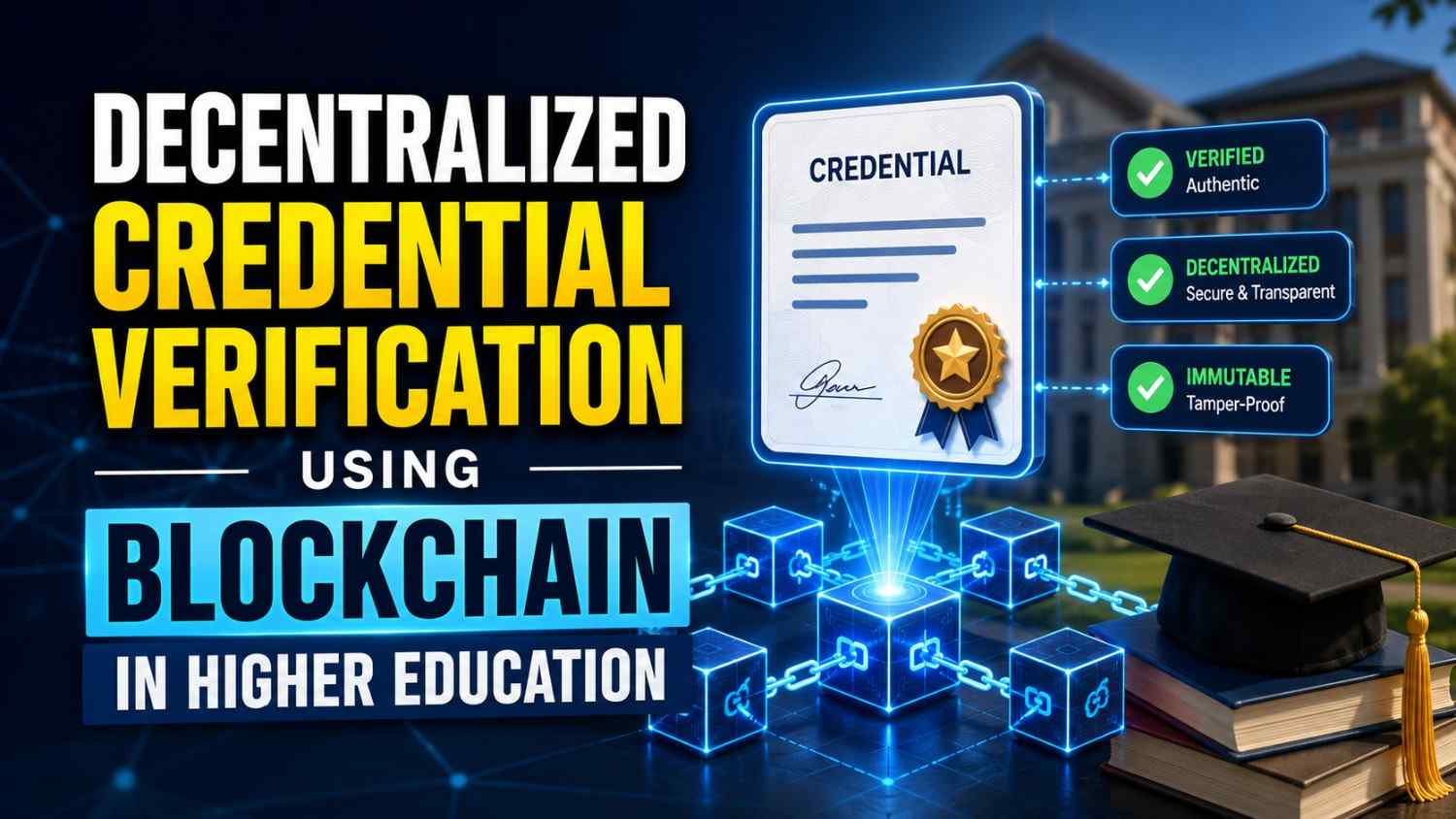
Blockchain in Higher Education: Imagine that you’ve had a great job interview after months of submissions. The interviewer requests documents proving your education instead of waiting for days or even weeks for your institution to reply to an inquiry for verification. You simply send an encrypted digital link. In just a few seconds, they can confirm all is genuine. There are no phone calls or faxes, and there’s no doubt about the authenticity. This isn’t some distant future scenario; it’s a current reality that is powered by blockchain technology that is being used in higher education.
As someone who has been following technology developments in education for a long time, I’m thrilled to see the way blockchain technology is transforming one of the biggest bureaucratic elements of life in the classroom, which is credential verification. Let’s examine the implications of this about what it means, how it’s relevant and how it’s shaping education and student experiences across the globe.
The Old Way: Why Traditional Credential Systems Are Struggling
The process of higher education is always about trust. The diploma is the culmination of years of dedication, as well as the knowledge acquired and skills that have been acquired. However, verifying faith in the old system is not easy.
The universities issue paper certificates or PDFs with basic content. Employers, other institutions or licensing bodies then need to get in touch with the school issuing the certificate to verify legitimacy. The process can take a few several days, or even weeks, if it is for students from abroad. Credential fraud is a problem. There are numerous instances of individuals who embellish or falsify education backgrounds on resumes.
The loss of documents, damaged records or institutions that have closed creates a new layer of stress. For those who have graduated across borders or switched careers several times throughout their lives, it’s a bit difficult to understand how the system is outdated in today’s digital world.
The higher education establishments also have the burden of administrative work. The Registrar’s offices are constantly answering verification requests rather than investing in teaching and innovation. In an increasingly competitive job market that is undergoing a transformation where micro-credentials and lifelong learning are becoming standard, inefficiencies are slowing everyone down.
Blockchain Basics: A Simple Explanation
Before diving deeper, let’s demystify blockchain. Consider it an electronic notebook that a lot of users keep copies of. When you write something into it, all copies update, and no one is able to erase or alter entries without the approval of the entire group. Each entry is secured by sophisticated math (cryptography), which makes altering the entry almost impossible.
In contrast to a centralised database managed by a single organisation, Blockchain is distributed. The information is distributed across a network of computers, which makes it more reliable and a lot more transparent. Some of the key features include:
- Immutability: After the data is recorded, it cannot be modified retroactively.
- Transparency and privacy: Everybody can see the integrity of the ledger, and personal information is protected.
- A decentralised trust: There is no need to depend on a single authority.
This technology, initially popularised by cryptocurrency, has also found applications that go beyond finance, including education.
How Decentralised Credential Verification Works
In a blockchain-based system, universities grant credentials in the form of digital documents that are anchored on the blockchain. We explore the fascinating world of the mind—breaking down psychology concepts into simple, ‘s a common flow:
- Issuance: When students complete an academic degree or course, the institution issues an online credential. It contains important information such as the name of the graduate (or an identifier that is unique to the graduate) as well as the date, degree and institution. Instead of storing all the sensitive information within the chain, typically kept as a cryptographic “hash” -a unique digital fingerprint. It is also accompanied by an electronic signature issued by the institution.
- Students’ Control: Graduating students receive the credentials through a digital wallet app on their mobile or desktop. They control and own access to the app.
- Checking for Verification: Anyone who wants to verify authenticity (employers or other schools) makes use of a simple device or hyperlink. The system examines the cryptographic signature and compares it to Blockchain records. If it’s a match to the record, it’s instantly verified. You don’t need to contact the school.
This is often based upon open standards such as Blockcerts, which MIT has helped to pioneer. Smart contracts–self-executing code on the blockchain–can automate rules for issuance or revocation if needed.
Students can also accumulate their certificates over time, forming the possibility of a portable “learning passport” that follows them throughout their professional career. ideal for micro-credentials and ongoing professional growth.
Real-World Examples Leading the Way
A number of forward-looking institutions have put in place these programs, which have proved that the concept is effective.
MIT was in the news in 2017 when it launched digital diplomas using Bitcoin’s Blockchain. Students could get tamper-proof versions in addition to traditional diplomas, and could be verified using a mobile app. The initial test showed that even top universities could benefit from the new technology.
The University of Nicosia in Cyprus is a leader in the field, issuing certificates using blockchain between 2014 and 2015, and accepting cryptocurrency as payment for tuition. They’ve created their own open-source tools, which other schools have adopted.
There are also pilots taking place in Malta, as well as a number of European and Asian universities that are experimenting with blockchain technology for micro-credentials and transcripts. In certain regions, for instance, regions of Africa and the Middle East, initiatives are dealing with fraud issues in the fast-growing education sectors.
There aren’t any major changes to be made yet, but they’re gaining momentum and improving the best practices.
The Benefits: Why This Matters for Students, Schools, and Employers
The benefits go beyond mere convenience.
Student: More control and transferability. Your credentials are able to travel in a secure manner. Sharing is simple and secure. You decide what information is shared. In the gig economy or with constantly changing jobs, this can help people who want to be lifelong learners. A lower risk of losing documents or forged documents boosts confidence.
For Universities: Massive efficiency gains. A lower number of verification requests means that employees can focus on their most valuable tasks. It boosts the image of institutions by demonstrating innovation and dedication to security. It also aids in combating fraud while protecting the legitimacy of any legitimately earned degree.
Employers and Society: Instant confidence. Recruiters have less time to conduct background checks and concentrate on evaluating the actual abilities. Recognition of cross-border skills becomes more seamless and supports the global mobility of talent. In general, it enhances the overall integrity of the education system.
Additional perks include better support for micro-credentials. With the explosion of online learning, small courses, badges and certificates are able to be awarded and verified the same way as degrees that are full degrees, allowing continuing education.
The environmental benefits of switching to digital can reduce the need for paper, but the use of energy by blockchain (depending on the kind of blockchain used) is a matter of careful management. Modern implementations utilise more efficient networks that are permissioned and secure.
Addressing the Challenges
The technology we use isn’t perfect, and education is one of the areas where blockchain is facing real challenges.
Adoption and technical barriers: A lot of institutions do not have the knowledge. Learning staff members and integrating them into existing systems requires investments and time. Smaller colleges could be more difficult than larger universities.
Interoperability: Multiple blockchains and standards have to cooperate. Initiatives to promote open standards can help; however, it’s a constant process.
Privacy and regulation: Balanced transparency and privacy laws (like GDPR within Europe) are essential. Solutions typically use zero-knowledge proofs or selective disclosure in order to only share the necessary data.
Cost and scalability: Initial setup costs money; future savings could be offset by this. Public blockchains may have problems with speed when they are used in large volumes, causing numerous education-related projects to adopt the private model or use consortia.
Cultural shift: The transition from traditional methods of paper to digital trust requires the support from faculty, administrators and students.
However, progress is still being made. A majority of projects start with small trials before moving to larger scales.
The Road Ahead: A More Connected Educational Future
In the future, digital credentials that are decentralised could change the way we view education. Imagine a world in which your accomplishments and qualifications are an authentic, secure digital portfolio that is continuously updated. Employers can match your skills more precisely, and education routes could be more adaptable.
Integration with other technologies, such as AI to provide personalised recommendations for learning or decentralised identity systems, could increase the benefits. Accreditation bodies and governments are increasingly examining the role of setting standards.
The technology also helps with equity. Students from regions that have unstable institutions or document systems can greatly benefit from secure records that are not tampered with.
However, it isn’t a perfect substitute for human judgment and traditional data in any scenario. It’s an effective instrument that can be used to complement the existing systems when they are in change.
Wrapping Up: Trust Rebuilt in a Digital Age
Blockchain-based credential verification that is decentralised is more than a technological upgrade. It’s about restoring and modernising confidence in education. Through making verification more efficient, more secure, safer, and more student-centred, it can address many of the issues that have plagued us for years, as well as open up exciting possibilities for lifelong learning.
If you are a university considering this route, beginning in the pilot program and focusing on open standards is a good idea. Staying up-to-date with the latest developments will help you in managing your academic path.
As someone passionate about education’s importance to the advancement of mankind, I believe that tools like this provide information that is easier to access, trustworthy and useful. It won’t happen overnight, the foundation is in place, and the possibilities are an inspiration.
Are you prepared to adopt a blockchain-powered certificate? The future of credentialing will be more secure and smoother than ever before.