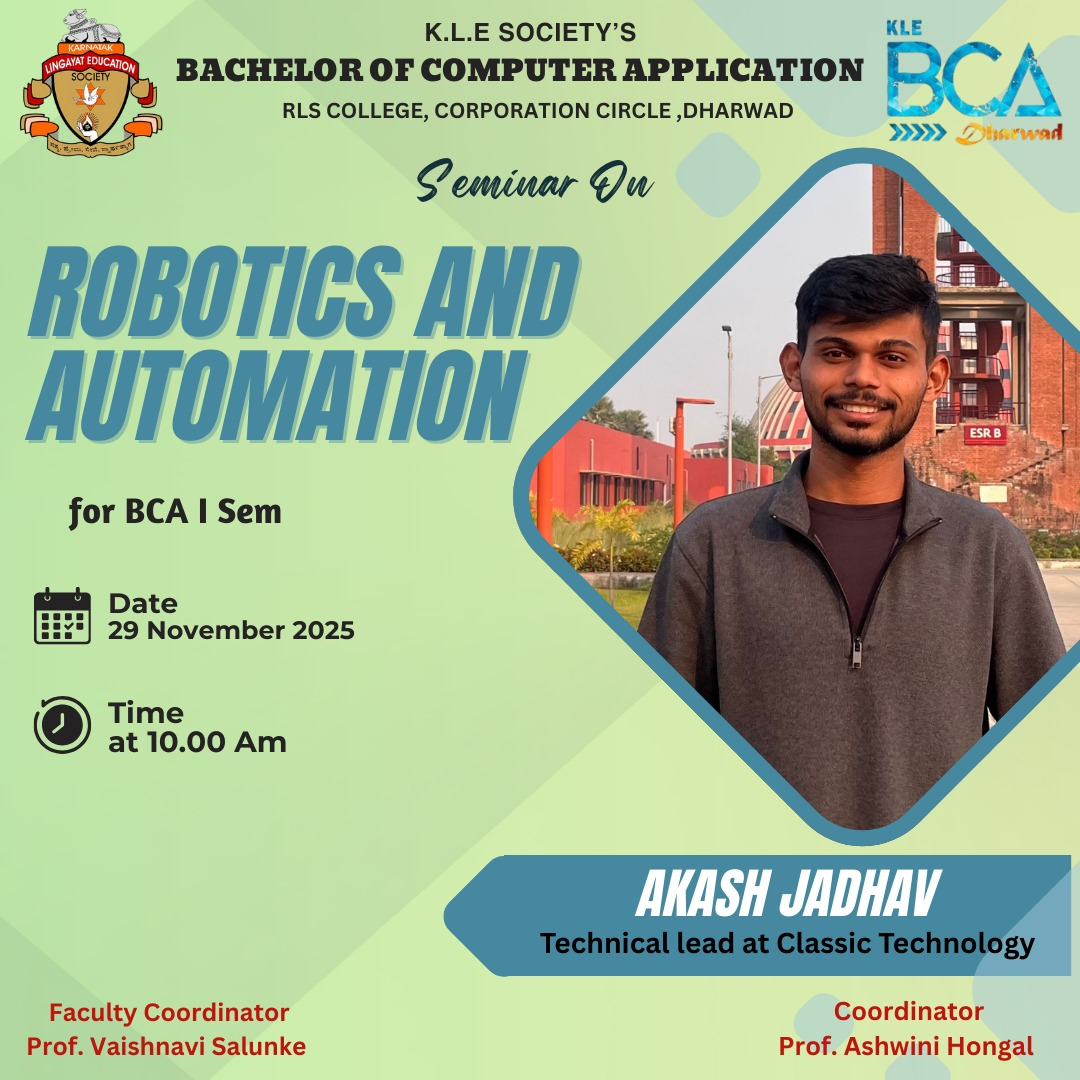
Last week, I stood in front of 80 first-year BCA students at KLE College in Dharwad, about to teach robotics and automation for three and a half hours. The catch? Most of them had barely any tech background. Some didn’t even know what a sensor was.
I won’t lie – I was nervous. How do you make robotics interesting to students who think robots only exist in Iron Man movies?
Turns out, you start exactly there.: Teaching Robotics to Students
The Movie Question That Changed Everything : Teaching Robotics to Students
“How many of you have watched Robot 2.0?” I asked as my opening line.
Eighty hands shot up. The room erupted with voices – “Chitti!”, “Rajinikanth!”, “That bird robot scene was crazy!”
And just like that, we weren’t talking about boring technical concepts anymore. We were talking about something they already loved. That’s when I realized the secret to teaching technology: meet people where they are, not where you think they should be.
Building a Chatroom Changed the Game : Teaching Robotics to Students
Here’s something I’m genuinely proud of. Before the seminar, I built a simple live chatroom system. Students could scan a QR code, join the room, and their messages would appear on the projector in real-time. I even added an anonymous mode.
Why did this matter so much?
Because in a room of 80 students, the quiet ones never speak up. The girl sitting in the back row who’s brilliant but shy? She’d never raise her hand. But give her a chatroom where she can type anonymously? Suddenly, she’s asking the most insightful questions.
Within five minutes of starting, my screen was flooded with messages:
- “Is Alexa a robot or just automation?”
- “Can we really build robots in BCA?”
- “Why don’t robots have emotions?”
The energy in that room shifted completely. Everyone was engaged, everyone had a voice.
The Moment They Realized Robots Are Everywhere : Teaching Robotics to Students
One of my favorite parts was the “Spot the Automation” activity. I asked students to find one example of automation in apps they use daily.
The answers surprised me:
“Instagram knows what I like before I do!” “My phone’s autocorrect finishes my sentences!” “Swiggy suggests food based on what I ordered last week!” “My mom’s washing machine stops automatically!”
You could see it clicking in their heads. Automation isn’t some future technology – it’s in their phones, their homes, their daily lives. They just never thought about it that way.
One student typed in the chatroom: “Sir, my phone battery saver mode turning on automatically at 20% – is that automation?”
“YES!” I said. “That’s exactly it. Someone coded that logic: IF battery is less than 20%, THEN reduce brightness, turn off WiFi. That’s automation!”
The room buzzed with excitement. Suddenly, technology wasn’t intimidating anymore. It was familiar.
Teaching Them to Think Like Programmers (Without Writing Code)
About halfway through, we did an activity that became everyone’s favorite: “Code the Robot.”
Here’s how it worked: I told students to write step-by-step instructions for a “very dumb robot” to pick up a water bottle and drink water. The rule? The robot has zero common sense and follows instructions literally.
The first group confidently wrote:
- Pick up the bottle
- Open it
- Drink water
Simple, right?
Then I asked a volunteer to act as the robot and follow those instructions exactly.
“Pick up the bottle,” the robot-student said. “Which hand? How tight should I grip? How high should I lift it?”
The class erupted in laughter.
They quickly realized: robots need EVERY. SINGLE. TINY. STEP. spelled out. That’s when programming clicked for them. It’s not about being smart – it’s about being extremely, painfully specific.
By the end of the activity, students had written 25-step instructions just to drink water. And they finally understood why coding can be so frustrating – and so rewarding when it finally works.
The Career Question That Made Everyone Listen : Teaching Robotics to Students
About two hours in, we hit the topic students cared about most: jobs.
“Can you actually make money in robotics?” someone asked.
I didn’t sugarcoat it. I showed them real salary ranges:
- RPA Developers (Robotic Process Automation): Starting salaries of 4 to 8 lakhs, growing to 15 to 30 lakhs with experience
- Automation Engineers: 3.5 to 7 lakhs for freshers, growing to 12 to 20 lakhs
- AI and ML Engineers: 6 to 12 lakhs for freshers, 20 to 50 lakhs for experienced professionals
The room went silent. These weren’t abstract concepts anymore. These were real career paths with real money.
But here’s what I made sure to emphasize: “You don’t need to move to Bangalore. Hubli-Dharwad is getting tech parks. Agriculture tech startups here need drone programmers. Local manufacturing units need automation engineers. The opportunities are coming to North Karnataka.”
One student typed: “Sir, my dad is a farmer. Can automation help him?”
That question led to a beautiful discussion about precision agriculture, drone-based crop monitoring, and automated irrigation systems. Suddenly, robotics wasn’t just about cool tech – it was about solving real problems their families face.
The Human Robot Activity That Brought Chaos and Clarity
The wildest part of the seminar was when I divided all 80 students into groups and asked them to create a “human robot.”
Each group had sensors (students who could only feel things, not see), a controller (who could give commands but not touch anything), and actuators (blindfolded students who could only follow exact commands).
Their mission? Move an object from one table to another using only this setup.
Total chaos ensued.
Controllers were shouting “Move left!” but actuators didn’t know how far left. Sensors were trying to communicate through touch but the controller couldn’t understand. Objects were knocked over. Students were bumping into chairs.
And then, slowly, groups started figuring it out. They developed hand signals. They created specific command languages. “Three taps means stop. Two taps means turn right.”
After 15 minutes of controlled mayhem, we regrouped.
“What happened when your sensor failed?” I asked.
“The robot was blind!”
“What happened when your controller gave unclear commands?”
“The robot got confused and messed up!”
“What happened when your actuators didn’t follow exactly?”
“Everything failed!”
That activity taught them more about how robots work than any PowerPoint slide ever could. They felt it in their bones: all three components – sensors, controllers, and actuators – must work perfectly together. One weak link and the whole system collapses.
The Ethics Discussion That Got Real : Teaching Robotics to Students
Toward the end, I brought up something most tech talks skip: the uncomfortable questions.
“If robots do all our jobs, what happens to us?”
The chatroom exploded:
- “Will there be jobs left for us?”
- “My uncle drives a truck. Self-driving trucks will make him jobless?”
- “Rich people will afford robots, poor won’t. Fair or not?”
I didn’t have perfect answers. Nobody does. But we had an honest conversation.
I told them: “Some jobs will disappear. That’s true. Toll booth operators are already being replaced by FASTag automation. Bank tellers are being reduced because of ATMs and digital banking. But new jobs emerge. Someone has to build these robots, program them, maintain them, teach them ethics. Your generation won’t compete with robots – you’ll work alongside them. That’s why learning this stuff NOW matters.”
One student raised a sharp point: “Sir, if automation comes to farming, small farmers like my father can’t afford it. Only big companies will benefit. Then what?”
That hit hard because it’s absolutely valid.
“That’s exactly the kind of question you should be asking,” I said. “Technology without ethics, without thinking about who it helps and who it leaves behind – that’s dangerous. If you go into this field, build solutions that are accessible. Create automation tools that small farmers can afford through cooperatives. Design systems that lift everyone up, not just the wealthy.”
The honesty resonated more than any motivational speech would have.
What Happens When You Show Them the Future : Teaching Robotics to Students
I showed them four short videos. Nothing fancy – just YouTube clips of Boston Dynamics robots doing parkour, Tesla factory automation, surgical robots performing precise operations, and a massive drone light show.
The room went dead silent.
After the Boston Dynamics video, one student whispered loud enough for everyone to hear: “That’s… that’s not real, right?”
“Completely real,” I said. “That robot exists today.”
You could see minds expanding in real-time. These weren’t science fiction fantasies anymore. This was happening right now, while they sat in a classroom in Dharwad.
After the surgical robot video, a student asked: “If robots can do surgery better than doctors, why do we still need doctors?”
Great question.
“Because robots don’t have judgment,” I explained. “A robot can make a perfect incision every single time. But can it comfort a scared patient? Can it make ethical decisions about end-of-life care? Can it explain treatment options to a worried family? That’s why doctors use robots as tools, not replacements. The human element still matters.”
What I Learned From Teaching Them : Teaching Robotics to Students
Here’s the thing about teaching: you learn as much as your students do.
I learned that first-year BCA students in Dharwad aren’t intimidated by technology – they’re intimidated by the way technology is taught. Strip away the jargon, connect it to their lives, and suddenly they’re not just understanding it – they’re excited about it.
I learned that a simple chatroom tool can be more powerful than a hundred PowerPoint slides. When you give students a voice, they use it brilliantly.
I learned that North Karnataka students don’t want to hear about Silicon Valley success stories. They want to know: “Can I do this from Dharwad? Can I build something that helps my community?”
And the answer is absolutely yes.
The Questions That Stayed With Me : Teaching Robotics to Students
As the session wrapped up, the chatroom filled with questions:
“Can I learn robotics if I’m not good at math?” “Do I need expensive equipment to start?” “Will companies hire BCA students for robotics jobs or only engineers?” “Can we really build apps that control robots?”
Every single question showed me they were thinking beyond the classroom. They were imagining themselves in this field.
One message stood out: “Sir, I never thought technology was for someone like me. Today I realized it is.”
That sentence alone made every hour of preparation worth it.
The Message That Stuck With Me : Teaching Robotics to Students
As the seminar ended, a student came up to me. “Sir,” he said, “I thought robotics was only for engineering students. I’m in BCA. I thought I couldn’t do this.”
“You’re a coder,” I told him. “Robots need code to work. You’re exactly who should be doing this.”
His face lit up.
That moment right there? That’s why I spent weeks preparing this seminar. Not for the content, not for the activities, but for that one student who now believes he belongs in robotics.
For Anyone Planning a Tech Seminar : Teaching Robotics to Students
If you’re reading this because you’re planning your own tech workshop, here’s my advice:
Don’t lecture. Engage. Activities beat slides every time.
Use tools that involve everyone. My chatroom wasn’t fancy, but it made every single student a participant, not just an audience.
Connect to their reality. North Karnataka farming problems are more relevant to Dharwad students than California tech trends.
Be honest about challenges. Don’t sell them a perfect future. Talk about job displacement, ethics, accessibility. They respect honesty.
Make it local. Show them opportunities in their region. They don’t all want to leave home.
Let chaos happen. The human robot activity was messy and loud and perfect. Sometimes confusion leads to the deepest learning.
Answer the money question directly. Students care about careers and salaries. Don’t dance around it. Give them real numbers and real possibilities.
What’s Next? : Teaching Robotics to Students
Several students asked me for the slides. Others wanted to know how to build the chatroom I used. A few are already messaging me about Arduino starter kits.
One group of four students approached me after the seminar. “Sir, we want to build a drone that can spray pesticides on small farms. Our fathers are farmers. Can you guide us?”
That’s the real success. Not how many slides I covered, but how many students walked out thinking “I want to try this.”
A Note to BCA Students in North Karnataka
If you’re a BCA student reading this – especially in North Karnataka – here’s what I want you to know: You belong in tech. You belong in robotics. Your background, your city, your college – none of that matters as much as your willingness to learn.
Start small. Learn Python on your phone using apps like SoloLearn. Try Tinkercad’s free circuit simulator. Join online robotics communities. Build one tiny project.
You don’t need to wait for the perfect opportunity. You don’t need expensive equipment. You don’t need to move to a metro city.
You need curiosity and a laptop. That’s it.
The student who asked about helping his farmer father? He’s already googling “affordable drone kits India.” The quiet girl who never spoke but asked brilliant questions in the chatroom? She’s already signed up for a free Python course.
That’s how it starts.
And who knows? Maybe next year, you’ll be the one standing in front of 80 students, teaching them that robots aren’t just in movies – they’re in your hands, waiting to be built.
Final Thoughts : Teaching Robotics to Students
Three and a half hours flew by faster than I expected. When I walked into that classroom, I thought I was there to teach robotics and automation.
But what actually happened was different. I watched 80 students go from thinking “robots are for someone else” to “maybe I can do this too.”
I saw eyes light up when abstract concepts clicked. I heard excited chatter about project ideas. I received messages days later from students who’d already started learning.
That shift – from spectator to creator – that’s what education should feel like.
Technology isn’t magic. It’s not reserved for geniuses or people from fancy colleges. It’s a skill anyone can learn if someone takes the time to explain it properly and believes in them enough to try.
Every single one of those 80 students has the potential to build something incredible. Some will create apps that solve local problems. Others will automate processes that make businesses more efficient. A few might build robots that change industries.
But all of them walked out of that room knowing one thing: technology is not out of reach. It’s right there, waiting for them to grab it.
And that makes all the difference.