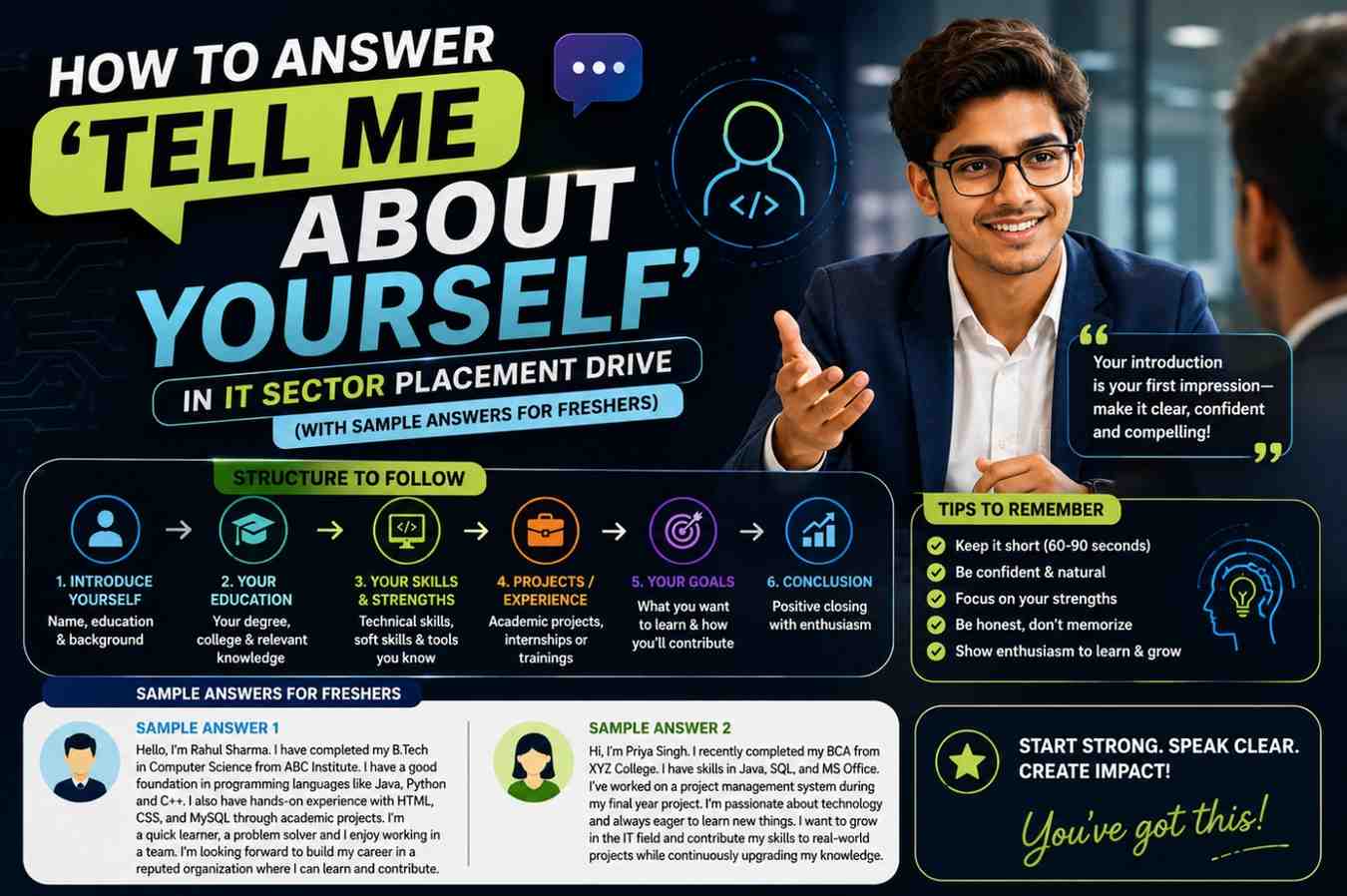
How to Answer ‘Tell Me About Yourself’: If there’s a single interview question that nearly all IT placement candidates have to answer, it’s this:
“Tell me about yourself. “
It appears straightforward. In the end, who knows more about you than you do?
However, this question can make some freshers anxious. Some start to narrate their whole life narrative. Others just repeat what’s in their resume. A few respond in two or three phrases and leave the interviewer with no understanding of who they really are.
The good thing is the answer isn’t about memorising an exact script. It’s about giving yourself a professional, appropriate, confident, and professional manner.
When you’re getting ready for off-campus or campus placements, interviewing, or for internships, understanding how to respond to this question will help you make an impressive first impression and establish the tone for the remainder of your meeting.
In this article, we’ll know why interviewers will ask for this information, what they’re looking for and the perfect structure for your response, the most common mistakes to avoid, and numerous sample answers that students can modify for their own.
Why Do Interviewers Ask “Tell Me About Yourself”?
A lot of candidates believe this is merely an icebreaker. However, the interviewers get invaluable insights from your answers.
They would like to know:
- How confidently do you communicate
- How do you make your thoughts clear
- What is the relevance of your experience to the job?
- Your self-awareness level
- What are the factors that drive you professionally?
Be aware that this isn’t an informal discussion. Each sentence should help the interviewer know why you’re the right candidate to work in IT.
What Interviewers Actually Want to Hear
A solid introduction will usually answer this question naturally
- What is your name?
- What are you currently working on?
- What are the technical skills you have acquired?
- What internships or projects did you complete?
- What are your professional goals?
- What are the reasons you’re attracted to this possibility?
Note that your answer doesn’t talk about your family background, hobbies, or childhood goals unless you’re specifically asked about it later.
Concentrate on your academic pursuits and prepare for your career.
The Ideal Structure of Your Answer
The most straightforward approach to address this is to follow a straightforward five-step process.
1. Begin by introducing yourself
Start with your name and the date you are currently enrolled in school.
Example:
“Hello, I’m Rahul Sharma, currently pursuing my MCA from XYZ University.”
Keep this short and simple.
2. Mention Your Academic Background
Be sure to describe your learning experience if it’s pertinent.
For instance:
- BCA graduate seeking MCA
- B.Tech in Computer Science
- A bachelor’s level degree is required in Information Technology
Do not mention each school you’ve attended.
3. Highlight Your Technical Skills
The next step is to apply the abilities you’ve acquired.
You can also mention:
- Programming languages
- Knowledge of databases
- Web development
- Cloud basics
- Control of version
- Platforms to solve problems
Make sure to include only skills that you’re confident discussing in the future.
4. Talk About Projects or Internships
Your introduction will be stronger because they provide a practical demonstration of learning.
Mention:
- Final-year project
- Personal project
- Internship
- Hackathon participation
- Contribution from Open Source
Instead of just giving the project a name, describe what you did.
5. End with Your Career Objective
Connect your abilities to the job you’re submitting your application for.
For instance:
“I’m looking for an opportunity where I can apply my technical knowledge, continue learning, and contribute to real-world software development projects.”
How Long Should Your Answer Be?
A well-crafted introduction can last between 60 and 90 minutes.
This length is sufficient to give valuable information, but not overwhelm the interviewer.
If you’re answering for more than two minutes, you’re likely not providing enough details.
Things You Should Definitely Include
Your introduction should include:
- Name
- Current degree
- Academic background relevant
- Technical abilities
- A couple of projects
- Internship (if there is one)
- Career objective
This combo results in a balanced solution.
Things You Should Avoid
Many candidates deliberately weaken their resumes by including inaccurate information.
Avoid:
- Family information
- Complete residential address
- Achievements at school that aren’t related to technology
- Stories from childhood that are long
- Weaknesses
- Expectations for Salary
- Personal issues
- Memorised robotic delivery
Remember, interviewers want to assess your professional abilities.
Sample Answer for MCA Fresher
“Good morning, sir/madam.
Hello, my name’s Aman Verma. I am currently working towards my master’s degree in Computer Applications from ABC University. I finished the requirements for my BCA with a keen passion for software development and solving problems.
Through my academic career, I’ve honed my proficiency in Java, Python, SQL, HTML, CSS, and basic JavaScript. I’ve also participated in various academic projects, like the development of a Student Management System developed using Java and MySQL, which I used to implement features like registration for students, as well as attendance tracking and the generation of reports.
To enhance my knowledge of the practical, I’ve attended online classes on Data Structures and Web Development, and I regularly work on coding issues to enhance my programming abilities.
I’m looking forward to beginning my job in the IT sector, where I will be able to constantly learn, collaborate alongside experienced teams and participate in significant software projects.
We appreciate your kindness.”
Sample Answer for B.Tech Fresher
“Hello, my name is Neha Singh. I recently finished my B.Tech in Computer Science.
In the course of my education, I discovered a keen passion for software engineering as well as the development of applications. I am comfortable working with C++, Java, Python, SQL, Git and object-oriented programming principles.
One of my main projects was to develop an online application for food ordering that was built using React as well as Node.js. This project taught me about the front-end development process and backend APIs, as well as integration with databases and collaboration.
Alongside my studies, I’ve been involved in contests for coding and technical workshops that helped me improve my thinking ability and the ability to communicate.
I’m thrilled to begin my journey in an organisation where I will be able to utilise my expertise, keep growing and learning, as a professional in the field of software.”
Sample Answer for Freshers Without Internship Experience
Many students are worried because they don’t have any internship experience.
Don’t panic.
Instead, concentrate on your self-learning and projects.
Example:
“Good morning.
Hello, my name is Priya Gupta, and I recently finished my BCA. While I was at school, I discovered a desire to learn more about web development and software programming.
While I’m not yet finished with an internship, I’ve worked on several personal projects, such as the creation of a portfolio website as well as a Library Management System using Python and MySQL.
I’ve also attended online classes on Java, SQL, and Data Structures to strengthen my technical base.
I’m an easy learner and am a fan of solving programming problems. I’m excited to begin my career within an IT-related company where I will be able to learn from the best professionals and make a difference.”
It is important to note that the absence of an internship isn’t portrayed as an excuse for weakness.
Sample Answer for Candidates with Internship Experience
“Hello, I’m Rohit Kumar, currently working on my MCA.
In addition to my academics, I also recently completed a two-month work experience during which I helped develop features for web applications that utilise HTML, CSS, JavaScript and SQL. In the course of my time, I also learned the ways that software developers collaborate by using Git along with agile development methods.
My main academic project was the development of an employee attendance system utilising Java as well as MySQL.
I’m enthusiastic about developing software and constantly increasing my technical knowledge through practical projects. I’m eager to contribute to an organisation that will allow me to develop and improve while providing high-quality work.”
Tips to Make Your Introduction Stand Out
Speak Naturally
Don’t sound as if you’re writing a script.
Interviewers can quickly detect answers they have memorised.
Instead, try to understand the flow and explain in your own phrases.
Smile Genuinely
A smile that is pleasant smile creates an impression of confidence and shows confidence.
Maintain Good Eye Contact
Do not stare at the floor or change your gaze.
A steady eye contact shows confidence and professionalism.
Keep Your Voice Clear
Talk slowly and clearly.
Rushing can make candidates appear anxious.
Match Your Resume
Every detail you include should be backed by your CV.
If you refer to programming languages, you should be able to answer any questions you may have about them.
Common Mistakes Freshers Make
Here are some common mistakes that are often a hindrance to interviews.
Speaking for Too Long
An introduction doesn’t have to be your autobiography.
Stay on top of pertinent information.
Mentioning Too Many Technologies
The ten programming languages listed could result in unrealistic expectations.
Concentrate on the areas that you are comfortable discussing.
Ignoring Projects
Projects demonstrate practical experience.
Even the smallest academic projects can add value.
Using Generic Statements
Statements such as:
“I’m hardworking.”
“I’m honest.”
“I’m dedicated.”
They aren’t very useful without examples.
Instead, show these traits by demonstrating these qualities through your own experiences.
Sounding Overconfident
The confidence of a person is appealing.
Overconfidence isn’t.
Don’t overstate your capabilities.
Practice Before the Placement Drive
The preparation of food can make a big difference.
Try this simple trick:
- Make your own introduction.
- Speak it out loud.
- Keep a record of yourself.
- Be attentive.
- Eliminate any unnecessary words.
- Make sure you practice until it feels natural.
The aim isn’t to remember every word, but rather to be confident in speaking about your own life.
Frequently Asked Questions
Do I need to mention my interests?
Only if they’re pertinent or the interviewer requests them later.
In your first introduction, you should focus on your academic background and skills in the field.
Can I use the same answer for every company?
Your introduction to the company can remain the same, but you must modify the end to match the mission of your business.
Is it okay to mention career goals?
Yes.
Make sure they are realistic and linked to teamwork, education and professional growth.
What if I forget a line?
Don’t worry.
Take a moment to gather your thoughts, then continue in a natural way.
Interviewers appreciate calmness more than flawless memory.
Final Thoughts
“Tell me about Yourself,” or the “Tell Me About Yourself,” is a chance to present yourself with clarity, confidence and conviction. A structured answer can help interviewers understand your educational background, technical capabilities, as well as your practical experience and excitement to start your job in the IT sector.
Instead of trying to impress using long explanations or complicated words, concentrate on telling an authentic and concise narrative of your learning experience. Focus on the skills you’ve acquired, the projects you’ve completed and your eagerness to grow and contribute.
It is important to practice your introduction a few times before the placement drive. The more comfortable you are with your personal story and your own story, the more confidently you’ll be able to speak during your interview.
A confident start often leads to a more relaxed conversation, which gives you a greater chance to show your potential throughout the interview.